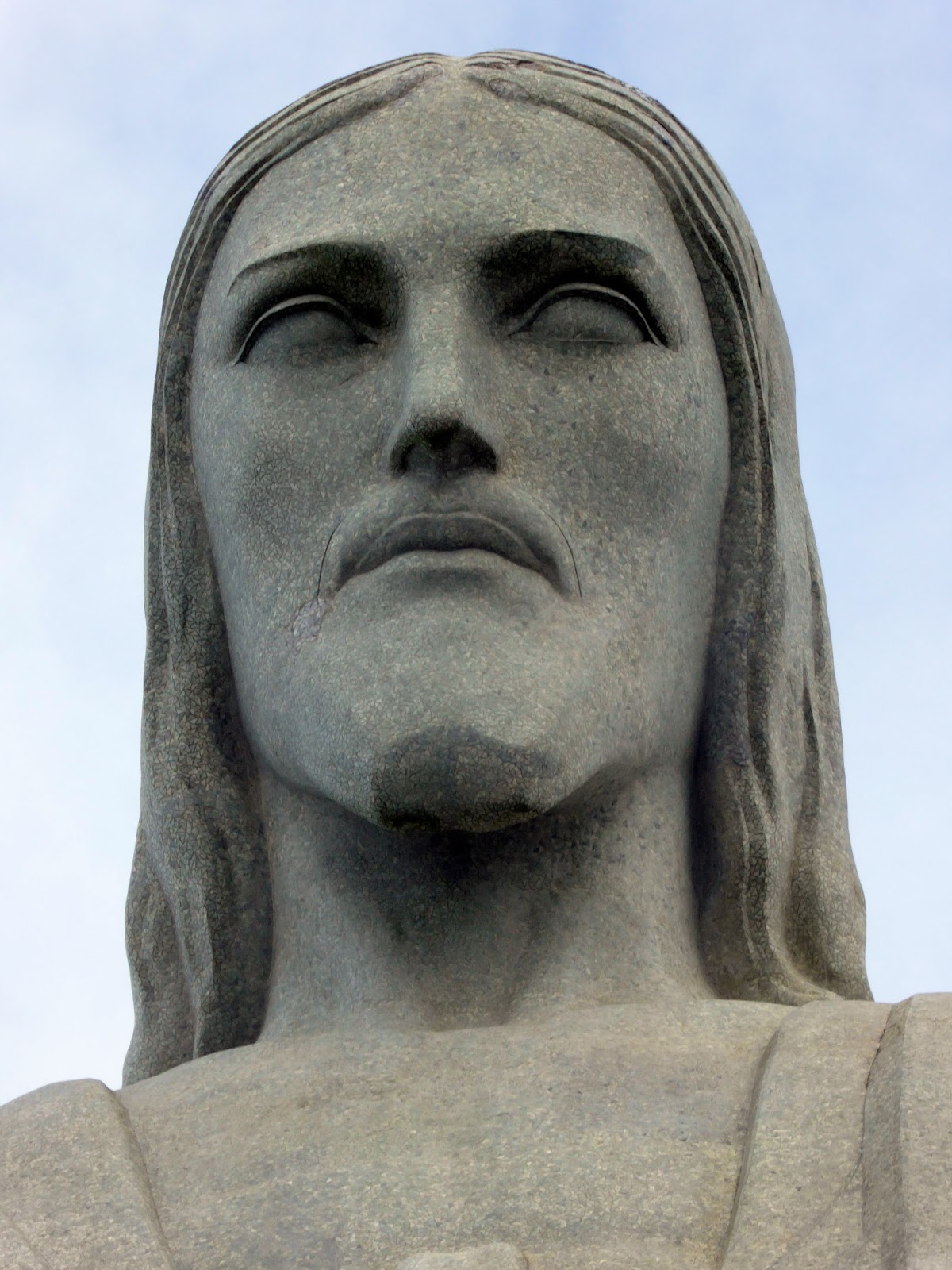
Cristo Redentor!

Last month we had our first visitors in Brazil and because they are so important, they not only get a mention but an entire post about our time together. The fact that we visited one of the most expensive and well reviewed restaurant in Rio, and saw a certain famous Jesus Christ on top of a mountain is just a happy coincidence.

Cristo Redentor (aka Christ the Redeemer), as I'm sure you are well aware, is a huge statue of Jesus in his most famous and patented pose, on top of a mountain. We have all seen photos of the iconic image of Rio and to see it up close from different angles and perspectives was exciting. We got the first train of the day like giddy school children and couldn't wait to find Christ. With my Jewdar in cranked up to eleven I managed to capture him as we were ascending towards this mountain idol.


The view from the top was great if slightly spoilt after about 20 minutes by a huge cloud that enveloped us and completely obscured the views. All in all it was a great experience and we all had fun. 


We did have fun and it was a good experience but for me it was the view of Rio that was the most amazing bit, and sadly that was short-lived because of said cloud. When it came to the actual statue, I couldn't help but feel a bit Pilkington about it. For me, the problem with these religious monuments is that once the initial awe and surprise of the size/beauty/decoration/engineering has worn off, that’s it really. For the millions of Catholics that visit Cristo, the spirituality and significance of his presence resonates and has great meaning for them which extends far beyond the initial wow-factor. Objectively I can see how having him on top of the mountain watching over the city would be comforting and important to them, but as an atheist it doesn't add to my enjoyment of the experience. I feel the same about stained glass windows in cathedrals - they are beautiful and I love looking at them but the fact that they depict biblical stories and events adds very little to my enjoyment or appreciation.

Anyway, other than the trip to see Cristo, what else did we do with our visitors? Well, not a great deal as they had already spent some time in central Rio and their time hanging out with us was somewhat limited. But we managed to squeeze in a walk along Ipanema beach and a meal at the aforementioned fancy restaurant, Aprazivel.

Aprazivel sits atop a hill in Rio, in an area called Santa Teresa. It's a pain to get to as the roads are terrible and really steep, but as you can imagine, the view is pretty amazing. I'll be honest - it isn't a restaurant that I would have chosen to go to and I'm not sure I'd recommend it for dinner as it was very expensive and the food wasn't anything spectacular. But for lunch or drinks I think it's worth going, as the view during the day will be even more impressive and the restaurant itself is definitely worth seeing. When we arrived we were shown to our table...up a tiny spiral staircase in a private treehouse! It was very quaint and amusing to see the waiter struggle up and down it with all of the drinks and plates! As you can tell from the photos, it was quite dark which added to the ambiance and after we had finished eating we went outside to admire the view. All in all it was a nice evening, although for a short trip to Rio there are others restaurants I would recommend over this one.

Dave's "Carnaval Octopus" with roasted veggies.
My tilapia with okra, rice and beans and a paste made from a weird Amazonian fruit that tasted a bit sweet
and a bit...off. Needless to say I wasn't too keen.
Our happy (but dark) treehouse table.
View from Aprazivel's terrace


Petrópolis: Imperial City in the Sky

Another four day weekend and another trip outside of Rio de Janeiro. This time we chose to stay in the state and visit the mountainous forest area of Petropolis with our good friend Thiago. A two hour drive up the hilly and beautiful scenic roads takes you to this historical town that was the first purpose built city in the country. I have no idea what purpose built means, as I am sure when the colonial settler landed in Rio de Janeiro, they were building homes for a purpose then too.

One clear purpose of Petropolis was to house the royal family and become the imperial city. The richest and most privileged colonists of the time including the king, queen, princes, and princesses were all residents here.

The city is dripping with history. Every building has a plaque outside explaining who used to live there and what these celebs did. We found the creator of the brewery we visited and thanked him kindly for his amber deliciousness. One thing we've been trying to do is learn more about Brazilian history and this was a great place to do this, but more importantly, feel it. It is one of those cities where you can almost transport yourself back in time and hear the conversations that would have happened in the street. The only problem was these imagined conversations were in Portuguese, which we are still not exactly fluent in!

The city of 300,000 is calm and peaceful – a world away from Rio de Janeiro. It is a pleasant hideaway from the chaotic city that can at times be overwhelming. We did not miss the hustle and bustle of the city during our long weekend there.

I wouldn't say that Petropolis is a must-see in Brazil but for long term travellers and expats like ourselves, it certainly is a lovely way to spend a few days.

The road we took from Rio to Petropolis
Excited little travellers we are!
The gate at the beginning of the imperial city
Imperial Museum - a very interesting place on the inside with a huge selection of photos of Dom Pedro II.
He really was a narcissist. Brazilians have mixed feelings about his reign.
The grounds around the museum are beautiful.

In the evenings the Imperial Museum hosts a historical show that is very different to anything we had ever seen. They project a video onto the water spray of a fountain. Truly spectacular and well worth it even ifyou don't speak Portuguese.

Beautiful Catedral de São Pedro de Alcantara at night
And during the day
Palacio Amarelo (Yellow Palace)
Some of the houses looked very Portuguese, with lots of tiles for decoration.
The city felt very quaint and naturey
Igreja (church) Luterana de Petropolis
There are a few canals that run through the city and although the water level was very low when we visited, they added to the European feel of the place. I bet someone, at some point has called Petropolis the "Venice of Brazil"
The Main Square. 
Here's a bit of wildlife for you Gary! I'll let you figure out what it is though.

We really liked the view of this church, as I'm sure you have guessed!
The Bohemia Brewery is a great museum / advertisement for beer. However, it was sold as a
brewery tour and that to me means you get to see a working factory, which we didn't. And
that is arguably 
the most exciting thing that can happen to a young buck of a chemical
 engineer like myself.
Cervejaria Bohemia - sadly these bottles were empty but there were a few beers included in the tour!

This is all the information we need to set up our own brewery.
Grab grab grab beer beer beer
I was fine to drive home!
The Petropolis Monument / Obelisk outside our hotel
Santos Dumont's house, He is the "father of flight"
Replica of Santos Dumont's 14 bis aeroplane.
I wouldn't have liked to tackle these stairs after the brewery tour!
Santos Dumont flew an airship at 77 km/hr
And of course, we saw a Mico!
Crystal Palace
This is called "The House of Seven Errors", which apparently means "The Spot-the-Difference House"! It was built by twin brothers who split it down the middle and each designed a side. How many errors/differences can you see?
This is the Quitandinha Palace - it's a huge, Austrian looking palace used to be a hotel and casino. Now you can look around for free at some of the extravagant and luxuriously decorated rooms, and it is used for conferences and corporate events.
It was our final stop before heading back to the city of Rio.

Minas Gerais In My Mouth

As David already mentioned in a previous post, the food from the state of Minas Gerais is considered to be particularly good. Although we only had a handful of meals during our trip, we did our best to sample as much as possible and here are the highlights:

Our first meal was in Sete Lagoas, on the way to the caves. David spotted a popular looking place that was similar to the kilo restaurants I described last month. I say similar because you didn't pay-per-weight, but rather paid £2.50 for as much of the buffet as you wanted, provided you only had one piece of meat. There was then an extra (very small) charge for each additional piece of meat. The food was really nice and we tried a couple of Minas dishes - okra and chicken, and beans with quinoa. Both were very tasty and a great start to the culinary adventure.

One of the main dishes we were really keen to try on this trip was feijão tropeiro - everyone I spoke to before we left mentioned this as one of the best Minas dishes. We tried it several times and I have to say the last time was the best by far but regardless, it is a really delicious way to eat beans. As you can see in the picture below, it's a dry dish of beans, egg (scrambled or fried), sausage, cabbage and sometimes pork scratchings. Everything is mixed together with the ever popular, sand-like farofa, which adds a lovely nutty flavour and brings the whole dish together. You can probably tell I was a big fan and Dave is always happy to eat a dish that contains multiple sources of protein!


Here is some slightly inferior (but still lovely) feijão tropeiro that we had at a churrascaria in Belo Horizonte. This type of restaurant serves "barbecued" meat. It is not the all-you-can-eat meat rodízio that you know as Brazilian BBQ in the UK, although that does exist here. Basically you order various cuts of meat by weight to be grilled. There is usually a minimum weight that you have to order per cut. We got some sausage, a wonderfully tender chicken breast with garlic sauce and some chicken hearts (for Dave).

Overly salty "linguiça"
"Corações de frango" with Worcestershire sauce


Next up was a lunch in Ouro Preto, where we opted for a restaurant that had a queue out of the door and down the street. Obviously. It was another buffet, with a flat charge for as much of everything as you wanted. There were a lot of typical Minas dishes: pumpkin stew, steamed pumpkin, okra and chicken, feijão tropeiro, quinoa and beans, cabbage, polenta and more. Our plates were piled high and a bit of a mess so the picture isn't great but I just want to prove to you that we eat vegetables whenever we get the chance!

One of the most famous foods from Minas which is eaten and loved all over Brazil is pão de queijo. This "cheese bread" comes in the form of a lovely crisp little roll made from cassava flour and cheese (often parmesan), with a soft, gooey centre. It is enjoyed as a snack at any time of day but is particularly popular for breakfast. As simple as it may sound, there is one problem we Gringos have when ordering this oh-so-common delicacy - pronunciation. There is a subtle but VERY important difference between the way to say "pão" and "pau". The former means "bread" and is a nasal sound that Brits are not used to making, whereas the latter is a much more comfortable, Batman and Robin sounding "POW!". But we're obviously foreign so surely we can be excused this tiny error...right? Wrong. Unfortunately, unless we pinch our noses when we order, we run the risk of asking for "cheese dick". Yup, "pau" means stick/peg/bar and is a very common slang word for a penis. Thanks Brazil.

Two espressos or "cafezinhos" with a round pão de queijo and a biscoito de queijo, which as far
as I could tell is exactly the same but a different shape and much safer to order without a cold 

or a peg on your nose! Amusingly Dave did pinch his nose when he ordered the pão.
The state of Minas Gerais has a lot of farmland, and we visited a restaurant that has a real farm-house feel. It is called Restaurante Xapuri and it was beautiful. There is a horse-riding field at the back of the restaurant and hopefully these pictures will give you an idea of just how rustic the place is. We ordered a pumpkin, stuffed with carne seca (a kind of dried beef) and topped with the famous Minas cheese that everyone raves about. It was huge and we had to take half of it back to the hotel for supper but we didn't mind at all because it was delicious. It came with rice, bean stew and garlic-fried cabbage - well worth the drive from the city centre if you ask me! But then again, I wasn't the one driving! The restaurant is huge and has a shop where they sell the many sweets, candied fruits and other desserts that they make. We were too full to try any of them but they looked lovely.


Plus free coffee and coconut cake for dessert!
Cheers Dave!

So that's all of the important Minas food done but there are just a couple more things we'd like to show you:

First up is was a dish of wonderfully tender beef, coated in a very popular cream cheese here called catupiry. It doesn't have a strong flavour and is lovely a creamy. Surprisingly, it makes a good pizza topping. Next to it is broccoli rice.

Next up is the obligatory meat-on-stick, although in this case it was more like a pork sword! Pretty standard grilled meat but with the interesting addition of a farofa coating. I hope you know what farofa is by now because I'm not explaining it again!


This cheeky little number is a kiwi ice lolly that we rewarded ourselves with after a long day of sightseeing in Ouro Preto. The reward may have also involved a passionfruit and lemon ice lolly...and a lychee one too! We were hot and tired and deserved it, trust me! The shop had huge freezers with what must have been over a hundred different flavours of ice lollies in and a lot of them were Brazilian fruits that I had never even heard of! One of the nice ladies that worked there took pity on my bemused face and let us sample a couple of the Amazonian fruit flavours. She thought she was being kind but let's just say there is a very good reason those flavours are not exported to Europe! I didn't know so many foul, bitter tasting plants were considered edible!

And finally, if we hadn't had enough weird food for one trip, we bought some sweets. This flavour combination is often called "Romeo and Juliet" and comes in the form of ice creams, cakes, sweets and probably other stuff too. I have no idea why it is named after the greatest love story of all time (excluding Brad and Angelina of course) because it is weird and disappointingly average. Cheese and guava. A kind of concentrated guava jelly is commonly eaten with cheese and crackers here, but why anyone felt the need to make sweets out of it is beyond me!
So there you have it. A true Brazilian foodie food post about food from Brazil.